Monday, 20 January 2014

Rough Cut - Miss Miller

 YouTube link to our rough cut:http://www.youtube.com/watch?v=H88l1vLEXZ8

 A rough cut is something very important to have considered during the time of filming as it gave my group and I the opportunity to reflect on our work with the help of others in order to gain an honest opinion and constructive criticism so that whether the product be finished or not, we would have the opportunity to improve our opening sequence. If we didn't do a rough cut, it would mean that we wouldn't hear the opinion of others and would as a result of this, not get our final product to the best of it's ability creating a lack in the amount of marks we could potentially get.

Feedback is something that my group and I value very much as without it, we wouldn't be able to take on board ways to improve our work. Getting feedback allows us to identify both our strengths and weaknesses running through our opening sequence to a thriller film, therefore we knew what was working well within our opening sequence with what to keep in it, but we found out what elements wasn't working particularly well so we knew to change them.

In order for  my group and I to get some feedback from our peers, we produced a presentation showing reasons for why we included certain editing styles, camera angles, what characters we used and why, iconography etc so that our audience gets a better understanding of the opening sequence so they would be able to give the correct constructive criticism because they are aware of what the opening sequence is about and have a clear understanding and perspective of our opening sequence. Further to our presentation, we also included our narrative, how our narrative is conventional to a thriller, what themes we wanted to present to the audience and why we included certain elements. During this presentation, we also made sure to include our rough cut which has been exported to YouTube so that our audience would have the opportunity to watch the opening sequence as much as they felt necessary in order to give us clear instruction on how to improve our work. 

As part of our feedback we received from our peers/audience, we discovered all of our strengths and weaknesses. Our strengths included:
  • The use of low key lighting as it showed something that was conventional to a thriller.
  •  The variety of camera shots we used. This includes a lot close ups and POV to represent enigma and hidden identity. The close ups show the characters facial expression which helps towards allowing the audience to build a relationship with the characters.
  • Different sound techniques used which helps create different atmospheres and can represent how characters were feeling, the different and unique use of sound also allows tension to build, leading to shock, surprise and suspense amongst the audience.
 These were also followed by some weaknesses such as:
  •  Lack of consistency through themes and characters created a lot of confusion amongst our audience.
  • Lack of conventional elements to a thriller, resembled traits of a comedy.
  • Order of shots seemed out of place and messy.
  • Rushed and unexplained ending.
My group and I were very pleased to see our audience responded well to our strengths and picked up on our hard work in these areas, and were still able to pay close attention to our weak parts of our opening sequence. My group and I found this to be very useful because as a result of this, we were able to re-film these parts. Due to our opening sequence feeling less successful than expected, my group and I agreed upon re-doing the whole opening sequence so that it could reach it's full potential. We made strong improvements by using the same characters the whole way through. We done this by making sure the characters we wanted would be available to film when we deemed as necessary so that there is consistency throughout. Another way in which my group and I turned our weaknesses into a success is when we changed the dialogue to be minimal, this left room for us to be able to develop the tension so our audience will be more shocked and surprise if something happens. Lastly, in order to get rid of all our weaknesses, we slowed the ending down slightly so the audience would be able to recognize what's going on and therefore get a better understanding of our ending, therefore it will no longer be confusing. Despite being able to restart our filming in order to gain a better grade being a positive thing, there is still a negative view on this. This is because we have re-filmed the whole opening sequence, which means the opportunity to present our idea to the class is no longer there, which means we were unable to get feedback and could only take ideas from our previous, rough cut so we have taken a risk. Yet, we have still kept everything the same with camera angles, sound etc, we've just adjusted the elements necessary. We have taken into consideration what our peers and audience thought and applied them into our opening sequence.

Completing a rough cut and getting feedback has helped my group and I with finalizing our opening sequence to our thriller. We have picked up on the potential reactions from the audience and how they may view our opening sequence, so we have been able to adjust certain small changed in order to get the best marks possible and achieve the best that we can.

Open Scene Naration - Miss Miller


The final narrative that my group and I decided upon using is about the celebration of an anniversary between a couple who become victims through an unknown killer. At the start there is a camera shot that shows the male character 'Dave' in his car, followed by a camera shot of his wife 'Stacey' at home preparing dinner and getting ready for her evening. There are different frames of my opening sequence that instigates the vulnerability of the characters and how they are or will be killed, however the identity of the killer remains unknown throughout creating a sense of enigma. We used a wide range of iconography to help emphasis the genre of this opening sequence (thriller) and many other things in order to engage our audience.

The first camera shot used is eye level from the left shoulder of the male character. My group and I had planned to use this as our first camera angle from our story board because we felt that having eye level made the audience feel equal to this character, there is no authority here and therefore this makes the character more approachable. My group and I felt this would be a good start to our opening sequence as it was the perfect setting for our opening credits to come in.


This frame that my group and I used is not what was originally planned and this is because we felt that we needed to introduce our other main character so that the audience became aware of who the characters are. Therefore the cinematography of mid-shot has been used. Mid shot has also been used to show the surroundings of this character, 'Stacey' whom appears to be washing up. This creates a stereotypical social norm of a female blonde victim doing the washing and therefore my group and I felt this would be strong to use as it shows the conventions that we have included within this opening sequence.

 The next frame that we decided upon using is mid shot but from the ground. This captures the unknown identity of a mysterious figure walking towards the house which confuses the audience into whether they should feel threatened or not. Having this after introducing the two main characters (victims) it is very misleading as it could be said that this individual is 'Dave' however due to the lack of any other clues given, the audience are completely unaware which helps towards creating a sense of shock, surprise and suspense.

We next decided that cinematography, P.O.V would be an excellent camera angle to use as it lures the audience into thinking how the killer is. This is also shown through editing where hand held camera is used. This alerts the audience that something bad is going to happen and shows that is a lack of stability and safety within this opening sequence.


After this, there was a use of another mid shot of 'Stacey' making a phone call because it makes the audience feel uneasy as to if the character feels secure or not. The reason or person she is calling remains unknown so therefore the audience begin to become fearful of this character because they have developed a relationship with her. However, shown below the audience are reassured to see she is only calling her husband, 'Dave'.


The location of the phone is unknown to the audience and due to an unknown person entering the house in the third frame it is unclear of the safety of Stacey. My group and I used this in order to create a sense of enigma and add to the tense atmosphere. However, as seen in the frame below you are able to see that it is the character of Dave answering the phone whilst in the car which indicates to the audience that there was an intruder entering the house where Stacey is. This creates shock, surprise and suspense amongst the audience as the use of soundtrack that has been used helps towards creating a sense of foreboding.

This camera shot has been used in order to capture the character of Dave and ultimately throw the audience as they have been lead into a false sense of security and are now aware of Stacey's potential danger.

In this next frame there is a dark figure which leads on from the conversation that Stacey and Dave have just had, and we decided to do this because it carries the theme of enigma in our opening sequence so the audience question who this dark figure is downstairs, especially because Stacey is last spotted in what the audience assume to be upstairs.
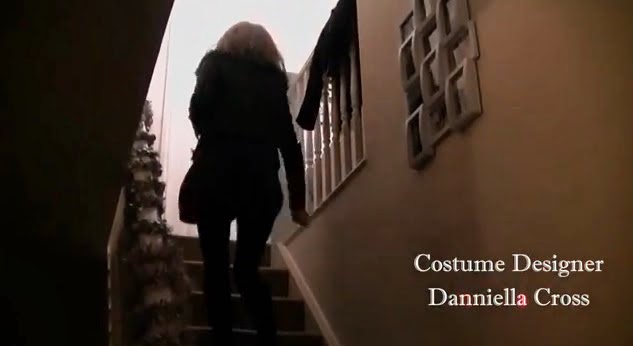
However, in this current frame that my group and I used which is low angle, it highlights Stacey's womanly figure and reassures the audience that she is safe and is okay. Low Angle has been used as it makes the character look powerful and strong which contradicts as we later find out because Stacey is the first victim. I felt this would be strong to use within this opening sequence as it goes with thriller conventions by tricking the audience into a false sense of security before something bad happens.

The next frame used is a close up of the mysterious person opening the door and entering the house where panning has been used. My group and I decided upon using panning as it allows the audience to follow the masked killers every move and to show the importance of this character and the significance that he holds.
Then we used high angle. I wanted to include this camera angle as it makes the character 'Stacey' appear to be vulnerable and weak which is the opposite of which is presented as two frames earlier. This gives the audience the idea that something bad is going to happen to this character because you can hear the on screen diagetic sound of the bath running so all other sounds are blocked out at this point, therefore indicating that Stacey is unaware of what's currently going on downstairs where the stranger has entered her house and this contributes towards making the atmosphere full of shock, surprise and suspense.

I then wanted to use a close up of two angles as I felt it represented the two victims in my opening sequence. These candles have a lot of significance to them despite their short appearance in this opening sequence. The candle on the left has been positioned so that focus goes mainly on that candle, this has been done to represent the character of Dave who is ultimately the first main character and the strongest out of the two, whilst the candle on the right seems to be on the edge more, out of focus which ultimately is preparing the audience for the events that are going to take place.

The use of iconography and cinematography within my opening sequence 'The Bloody Suit' makes the audience feel uneasy towards the situation as they are now aware that there is an intruder in the house which is the inspiration used from Halloween Town (1978) which makes the audience feel scared for Stacey so therefore I felt it would be excellent to use within my opening sequence.
Low key lighting has been used within this opening sequence in order to allow the possibilities for shadows to form and for the audience to be one edge. This creates a sense of shock, surprise and suspense as the audience are aware that there is something bad waiting to happen to this vulnerable character so my group and I felt this would show a clear indication of the vulnerability and weakness of this character.
In this frame I have used a close up of the iconography because it's emphasising the importance of this. It also shows how I was able to follow the conventions of a thriller in order to produce a successful final product. Mise en scene used where the positioning of this knife is, is on the stairs. This indicates where the intruder is set on going, and the audience are aware that Stacey has going upstairs so therefore they become more fearful for this character as they have developed a relationship with her through costume, hair and make up.

We then here an off screen sound of someone knocking on the bedroom door. The audience at this point are aware of the danger that this character is in and urge Stacey to escape whilst she can, however, this emphasises how naive Stacey is which reinforces the convention of a blonde female victim and continues to create tension.

In this frame,  panning has been used from where Stacey goes to open her bedroom door to where she attempts to run away and is the killed by this masked killer. My group and I felt this would engage the audience as they would feel sympathetic towards Stacey and upset that she has been killed.

As discussed earlier, the candles here are very useful within this opening sequence as in this frame the candle that represented the character of Stacey has gone out. This is a representation off Stacey's life and how she is now dead, whilst Dave is still alive which we felt would give the audience a sense of hope.
In this frame, we continued to film in the bathroom as we felt it showed how the bath had been neglected because Stacey has been killed, the bath has also been left running by the killer as it shows a sense of normality for Dave because that's what he's routine usually is. Therefore, Dave isn't aware his wife is dead yet and is therefore not fearful of what's happened or what is going to happen.
In the next frame, mid shot has been used. This has been used in order to capture Dave and his costume which makes the audience subconsciously warm towards him. Ultimately, the audience feel confident in this strong character despite them being fearful of the events that could take place.


The next frame used is a close up of the bathtub. This shows that there is still a sense of normality to the character of Dave and makes the audience feel slightly safer as there is also no sign of the killer at this point. However, the audience are prepared for Dave to discover his dead wife which ultimately continues to add tension to the atmosphere.


In this frame the audience will be able to see that there has been editing used of shot reverse shot. This makes the audience see that the character of Dave continues to appear to be strong and confident. The costume of a smart suit makes the audience feel this is an authoritative character and can therefore depend on him as the strongest one throughout the opening sequence.

In this next frame I have used hand held, P.O.V camera. My group and I agreed upon using this as we felt it showed a chaotic event going on and allowed the audience to feel uneasy because this dominant character is being watched about and instead of being strong like how Dave is first perceived, he is weak and vulnerable. Therefore I want to include this within my opening sequence as the P.O.V shot shows the audience that the killer is the most powerful and that the victim is weak. Also we wanted to include handheld camera as it shows an unbalanced show which can be said to be how the killers mind is so it is included within this opening sequence metaphorically.

The next frame used within this opening sequence is seeing Dave come up the stairs, and an oblique angle has been slightly used. I wanted to use this oblique angle as it shows the psychological issues of the killer and soon to be next victim whereby everything is going to be unbalanced.
At this point, Dave's fate is unknown to the audience however as Dave goes to approach the room in which he is going to find his wife dead and I thought that by adding in a P.O.V hand held camera it would show that there is someone watching Dave. This is because the masked killer is waiting for Dave to discover his dead wife before he then kills him, which follows the conventions of a thriller and makes the audience feel uptight and fearful of what could happen.

In this frame, my group and I relied on special effects in order to create a great impact on the audience. This is because within this frame there is a blur which can be said is a metaphor for how Dave views his findings. This means that the audience feel sympathetic towards Dave as it shows how he is feeling and makes them want to help him. The sudden non-diagetic sound emphasises how dramatic this part of this opening sequence is and engages the audience further as they want to know more about what's happened or what is going to happen to Dave.

In this frame, my group and I decided to black out the frame as we felt it would leave our opening sequence as a cliff hanger and therefore engage our audience further. The silence within this part also allows shock, suspense and surprise to take place and therefore we felt would follow the conventions of a thriller.


Saturday, 11 January 2014

Individual Storyboard - Miss Miller

Storyboards are used to gather idea's and set 'guidelines' for a film, in order to maintain structure and correct order of how the film will be shot. By having a story board, it allows the producer of the film to be able to give clear instruction to other members of the production cast in order to create a successful film. Before creating my group story board that my group and I will work on, the use of my group and I's individual story boards allows us to consult one another about what we feel are our strong qualities and exchange ideas in order to create a successful group story board. Doing an individual storyboard created by myself allows me to explore the skills I have learned and apply them to my own ideas on how I believe my opening sequence with my group should go and what different types of editing will be used.

The first page (shown to the left) establishes the setting of the first scene.In this scene shown on the first shot, there is a man driving in his car on his way back from work. Showing a strong male character is already reassuring the audience that there is a sense of safety, however the car is alone and so is the man. This represents isolation whilst introducing the main character, therefore making the audience clearly aware of what's going on. I felt this would be a wise  idea as it sets the scene well and introduces the main character of the opening sequence well. I felt by doing panning, therefore showing every action of the car gave a thriller-like feel to it as it looks like the car is being watched, this in forces a sense of suspense which is crucial because it follows the conventions of a thriller. Despite the element of using a male as the main character, representing safety and strength, the loneliness of this character driving in a quiet road also contradicts the character as when someone is alone they're thought of as vulnerable.  

Continuing onto the next shot which is POV, it shows what the main character is able to see and once again reinforcing the surroundings of where the opening sequence is set, yet misleads the audience as they aren't aware at that point, that the 'crime scene' is in a different location. To help introduce another character, 'Stacey' whom is the wife, it shows an introduction to another important character, this shows the audience that the opening is imaginative and creative as it introduces not only new characters, but the possibility for new locations, therefore engaging the audience.

I feel the first four shots shows clear understanding on my behalf on where to position each character and how to establish clear pieces of important and relevant information to the audience. Including things like a long shot allows me to show the audience all the property within the room and the layout helps the audience to become familiar and actually helps to create a relationship with the audience.

 Looking at the second page of the shots I believe would be successful if used in our group story board, I believed the duration time for frame number 5 to be 8 seconds as it is a long enough time to show the audience about layout and allow them enough time to pay attention to detail subconsciously, therefore when something bad happens, they will already know the layout of the house and save confusion. Having iconography such as a knife within this shot contributes to the many conventions of a thriller that I have included, as well as low key lighting and the loneliness of this female victim showing vulnerability. This shot also allows us to see the important of the unlocked back door behind her, giving the audience a sense of foreboding.

By then including POV which was previously used in the shots before hand when 'Dave' is looking at the road whilst driving, makes the audience believe the character entering the house is him. This is misleading to the audience and would create a large element of shock, surprise and suspense because as the scene continues, the camera angle changes to birds eye view of Dave getting out of his car that's pulled onto the drive, and walking up towards the front door. By this point, I would have deeply engaged the audience to pay close attention to what's going on and this would heighten the tension amongst the audience.

 
Looking at the third and last sheet of paper which contains all of the elements I believe would be successful, I have included in the final shots conventions of a thriller film such as small dialogue, this is shown when my character 'Dave' comes home and says 'Honey, I'm home!'. Dave is greeted back with a silent response from his empty house and begins wondering around. I believed this would be powerful within my opening sequence as it shows the stereotypical idea of a husband arriving home to his wife but confuses Dave as well as the audience into a false sense of security, which I felt was a strong feature to include.

The last shot is a close up of the killer, the dark background with the killers mask highlighted makes the audience feel insecure and tense. Throughout the thriller there is no sign of what the killer looks like and once Dave arrives home, it is unclear as to whether or not the killer is still in the house. By having this close up of him, with a scary and scared mask with blood stains on them, it indicates the danger that goes with this character, and when the screen goes blank after seeing this killer, it engages the audience further to want to carry on watching this thriller. Another feature that adds to this is the fact that this killer is still masked, and in most thrillers there is a sense of enigma- it is an important convention to a thriller, therefore  by including this into my own idea I felt it would be powerful to help sustain the attention from the audience that's needed.

By having done and created my own story board, I was able to realize the importance of each element that go hand-in-hand with a successful thriller. I was able to get a clearer understanding of how to pursue my ideas and hope that they come out as good as I imagined. I feel I have included some strong elements and conventions that I believe to be helpful when creating my group story board, when we all converse with one another and gain ideas from each other that we would deem fit to put in our own opening sequence. It is important within a thriller to have shock, suspense and surprise and I feel that my story board contains all of these things that are shown above in my 12 frames.  However, if I were to redo this I would most definitely explore more techniques by adding more frames into it which would allow me to use a wider variety of conventions that include editing, camera shot, iconography, lighting, sound and editing. I do feel that when it comes to creating the group story board though, my ideas are creative enough to help contribute to a successful production.

Sunday, 29 December 2013

Narrative Theory - Miss Georgiou

There are three theorys produced to help explain the purpose of character in films. These fall under Vladimur Propp's theory, Todorovs Theory and Aristotle's theory.

Propp's theory is mainly seen in fairy tales and make believe where there are eight clear characters that contain different functions in order to make the film work properly. He believes that in such thing as a fairy tale, for example, Shrek, there should be a hero, villian, donor, dispatched, false hero, helper, princess and father. This is not relevant to a thriller because you will not find these sort of characters within them, this theory is suitable for a fairy tale and often animations/cartoons because it helps it function and unbelievable, it wont be found in a thriller because thrillers can be based on something that could happen and to help create a sense of reality, if thrillers used Propp's theory there would be no reality to any of the situations.

Another theory that has been made is by Tadorov. This theory is based upon equilibrium and disequilibrium. Equilibrium is where everything is as it should be, where as disequilibrium is the complete opposite and full of disruption.

Lastly, Aristotle came up with another theory. He believed in each film there should be inciting incident, dramatic question, character goal, antagonistic/protagonist, stakes, resolution, sympathy and empathy. These elements help produce a lot of insight as to what makes a good thriller as it can often be a realistic approach because the elements used creates the 3 S', shock, surprise and suspense.

The theory of which our narrative falls into is Todorovs. This is because the narrative at first comes across as quiet normal, the scene will be set in is something that has a lot of reality to it and and therefore comes across as everything as it should be however the clip takes a turn for the worse because there are murders involved which proves that everything isn't how it should be and therefore because our opening clip will be like this, it goes with Todorovs theory.

Planning group story board - Miss Miller

A group story board is a guideline for cinematography, iconography, editing and lighting will be used within our opening sequence for a thriller.  In order to get these ideas together for our group story board, my group and I first had to look at our own and each others individual story board so that we could discuss the idea's in order to make a successful group story board.

My group and I created this group story board and included specific elements from each others individual story boards because we felt it would create a successful group story board. For example, on the first sheet on the first camera angle, Vasil suggested that we do an eye level camera shot because we felt it showed the audience an approachable character by having it at eye level allows the audience to build a relationship with the character.  Also, Vasil suggested that we use low key lighting in this shot, and because this is the first scene used the use of low key lighting could be a metaphor for how the film's going to be quiet dark and mysterious, so George and I felt this would be a particularly good thing to include in our group story board.

George helped to create a fantastic element to add in our group story board shown on the last sheet on the first one on the right where the husband comes face to face with his dead wife. He said it would create a lot of tension because there would be silence leading to this point so the audience would be feeling tense and nervous, so it would be achieving typical conventions of a thriller such as shock, surprise and suspense. We decided to use a close up at this point because close ups show the facial expression and emotion that a character either is or isn't feeling. George suggested that by using this at this point in our  group story board it would be very effective and engage the audience because they wouldn't expect it so Vasil and I felt this would be a good feature to include in our group story board.

Lastly, I took from my individual story board an idea to include in the group story board which can be seen on the last sheet on the last camera angle which was to have a close up of the killers face for a brief moment and the reason for this is to finish the opening sequence off with a shock to the audience and to in force the theme of fear and enigma in it. Vasil and George wanted this in our group story board as they felt this was a strong idea to include and help made the thriller more realistic because the audience are therefore able to match the killer with a face, even if it is a mask. Often 'less is more' as it leaves to the imagination, and in most circumstances with thrillers this would be perfect to use, but we felt that as a group it would be the most effective to link an image with our killer as we felt it would create more of a relationship between the audience and the killer.

Looking at each others story board contributed to a large part of our opening sequence as it was stable and strong. Being able to reflect on our story board allowed us to work well together and produce a strong piece of work because the story board gave us our 'guide lines' as such in order to make sure our opening sequence made sense and to keep our trail of thought tracked so we were able to expand on our ideas each time we meet and explore different techniques using each others ideas. I believe our story board shows a confident piece of work with creative ideas and skills that we have all learned. However, if there were an opportunity to redo this task I would change the narrative description so there was a clear and in depth annotation of each camera shot to show that as a group we were able to understand what the techniques we want to include will do to the audience and to show that we are able to use a wide variety of different elements that are conventional to a thriller in order to show clear understanding of why we used these techniques.


Questionnaire - Miss Miller

Voxpop 1: http://youtu.be/8j9n91jS7pg


In order to get a better understanding of what type of things to include in my opening sequence, my group and I carried out a questionnaire answered by an audience consisting of the ages 15+ who happen to also be the target audience for our opening sequence. The questions that were are will be listed below and then discussed accordingly to the results of our questionnaire.

We asked 40 people to answer this questionnaire from the age range of 15+. Despite our target audience being 15, we felt that by gaining the opinions of an older audience would help us to deliver a powerful piece of work when our opening sequence was finished and therefore we valued each persons opinions and took it all into consideration. However, the majority of people who answered our questionnaire are outside of our target audience and therefore this may affect our results greatly as we may make decision that may not always appeal purely to our preferred target audience.


In the chart shown below it shows that the majority of the people asked where men, 17 female and 23 male. This makes a huge impact to the results for our questionnaire as stereotypically men are said to be more brave and more able to therefore watch thrillers than women as women are perceived to be weak and scared easily. This means that our results may cause for our opening sequence to be more violent and brutal because the results conclude that there is a high tolerance in our audience being able to watch a more fierce thriller. Therefore my group and I have decided to pay particular attention to females opinions too so that there is an even balance and so that our opening sequence is appealing to both genders of our target audience. For example in our opening sequence we had planned to show the blood of our victim, however, after viewing the results of the questionnaire we felt we would our audiences view into consideration and change this so that the intention of the scene and shock would still be there, but the way in which it will be shown isn't so graphic.


Having looked at our questionnaire, it was obvious that not everyone has watched a thriller because the genre doesn't appeal to them, therefore my group and I felt it would show understanding to these people by including this option of telling us if they had ever watched a thriller movie. By doing this, we was able to clarify the people that would be able to give accurate results based on their own beliefs, rather than someone randomly selecting options for the sake of filling out our important questionnaire that helps us research what our target audience would like to see in our opening sequence of a thriller. We felt it would also be good to ask this to our audience because we want our thriller to appeal to everyone, and change those minds of not wanting to seeing a thriller. We felt by seeing the 5% who had not yet viewed a thriller, we could incorporate ideas that would help engage them and ultimately help our opening sequence be successful.

 By asking our audience if they enjoyed thrillers, it would help us to gather a good understanding of how our audience would feel towards a thriller. If, like the12 out of the 40 people dislike thriller movies, then my group and I would like to include features in our opening sequence in order to make it an enjoyable experience for our audience. If , like 28 out of the 40 do enjoy thrillers then it makes our job to produce a successful opening sequence slightly easier as it means that the audience going in to watch it are more open minded to watching our opening sequence. We plan on making our opening sequence more enjoyable for the percentage that don't enjoy thrillers because we know to include characters that our audience can relate to more, therefore making the experience of watching our opening sequence of a thriller more enjoyable because the characters will be more approachable.
Moving onto asking the next question of 'if you were to direct a thriller, what would your target audience be' contained a variety of results; the purple is for 15, blue is for 12A and green is for 18.We felt that by using this closed question it would help us to get specific answers and therefore would be more effective and easier for us to know what to do when it comes to our opening sequence. Asking this question allows us to get a rough idea as to what kind of thriller we will be making, for example the results show that the most popular target audience is 15 which has been selected by the majority of the people that answered our questionnaire, we can infer from this that by choosing our target audience to be 15, we would get far more views than if we were to target an older audience. However, by choosing such a young target audience, it means we have to be careful as to what we include in our opening sequence because otherwise some scenes could contain things unsuitable for 15.

In the below question I believed this would be an effective, open question to ask. It gives our audience the opportunity to give their opinion into what type of thriller they'd be interested in watching so that we could take inspiration from them and apply it to our work. This means that our opening sequence would have elements suggested by the audience and would ultimately mean that it would engage them and because it is their suggestion, they would therefore want to watch our thriller. Also, by getting an insight as to what our audience enjoys and what they would include in their own opening sequence if they were to make one, it allows us to get a better audience. Our audience selected that the setting of which they would use is a house. Due to this research, my group and I will make sure the main setting is a house, we feel that this would be a strong feature to use as it suggests vulnerability because a house is typically seen as a secure place where people feel safe, so by using a house it shocks the audience and can therefore make them feel vulnerable as most people are able to relate to the safety they feel when they're at home, and for something in our thriller to make them question their security in their own home means that we were able to successfully use the setting of a home to our advantage in order to make our thriller stronger.

To conclude, as shown in the above results, there is a variety of open and closed questions. For example, the open questions used are 'What setting would you personally use in a thriller?', and 'if you were to direct a thriller, what would your target audience be?' We used these open questions as it gives the people asked, the opportunity to voice their own opinion in which we would gather their choice and incorporate into our final product. As well as asking some open questions, we also felt that asking closed questions would be good because this means the answers were specific and straight to the point, ultimately allowing us to gather the results quickly and effectively. Ultimately, doing this questionnaire has helped my group and I to gather interesting ideas and helped us to see areas in which we can expand on in our opening sequence so that our thriller contains shock, surprise and suspense and therefore be successful.

Filming Schedule - Miss Georgiou

A filming schedule is something extremely important to have during the time of producing something. In this case, my group and I are producing an opening sequence to a thriller with our own unique ideas put together. Filming Schedule's are important to have as they indicate specific place and a helpful guide as to the place that we will shoot our opening sequence. The Filming Schedule allows us to get a clear understanding of what to do during our filming, as well as allowing us to remember each detail of where certain shots are filmed and the location of everything.

Shot
Date & time
Location
Content /Action
Shot type & Duration
Costume/ hair/ make up
Iconography
Personnel
Equipment
1
2/12/13
2:00pm
Torrington Drive
Antagonist passing by with his car
Panning shot
5 seconds
Antagonist: dark clothing, which helps to hide his identity
Newspaper, knife,
Actor 
Digital camera, batteries, memory card, 
2
4/12/13
4.30pm
Torrington Drive
Antagonist picking up phone and talking to his wife
Eye level shot
10 seconds
business clothing
phone
Huband
camera, batteries, sd card, tripod, car
3
5/12/13
5pm
My House (Kitchen)
Wife finishing conversation and then starts to cook; The two candle scene; Husband checks for wife and eats a mini puding
eye shot,
high angle, low shot
5 sec,
10 sec,
15 sec
apron and a  spring dress
cutlery, stove, table, candles, chillies, etc.
wife, husband
camera, batteries, sd card, tripod
4
7/12/13
3.30pm
My House
(Garden and front)
Wife opens door and goes to throw away rubbish bin; Killer enters house scene;
Killer choses knife;
Husband parks car and enters house
establishing shot,
point of view,
establishing shot,
10,10,10
towell, spring dress,
dark clothing
rubbish bag,
knife
wife, killer
camera, batteries, sd card, tripod
5
8/12/13
12pm
My House
(Upper floor)
Wife takes a shower; She changes clothing; Killer knocks; She is killed; Husband finds her in his wardrobe; Runs to Bathroom
High angle shot,
Low angle shot,
POV,
two shot
same time as previously
Ketchup for blood on the mirror.
mirror,
wardrobe,  mask
wife, killer, husband
camera, batteries, sd card, tripod


During the filming schedule, we followed every step precisely and exact in order for us to end with a successful final product. We followed the schedule because our group did lack organisation and arrangements, so therefore because we had the schedule we were able to maintain our time and be organised throughout the whole filming process. I feel that the filming schedule was extremely significant whilst we produced our film as without it, it would have taken a lot longer to get to the final result.